
Techniques · Knee
Partial knee replacement surgery in Calgary
If your knee arthritis is limited to just one part of the knee (most often the inner/medial side), you may be a candidate for a partial knee replacement — resurfacing only the worn compartment while keeping the rest of your natural knee.
What it is, in plain terms
What is a partial (unicompartmental) knee replacement?
A partial knee replacement resurfaces only the worn compartment of the knee, preserving your ligaments and healthy cartilage. It treats arthritis confined to a single compartment of the knee — most often the medial (inner) side. Your ACL, PCL and collateral ligaments and healthy cartilage stay put, so the knee moves and feels more like your own (Total knee replacements typically remove ACL and possibly PLC ligaments).
Which part is worn? Tap to explore.
A partial knee resurfaces only the worn compartment — the rest of your natural knee stays intact.
The most common site of isolated knee arthritis and the classic target for partial knee replacement.
Only the worn part is resurfaced — the other compartments and both cruciate ligaments stay put.
Careful selection
Am I a candidate for a partial knee replacement?
Partial knee replacement suits carefully selected knees with arthritis in one compartment, intact ligaments (especially the ACL), a correctable deformity and good movement. Your surgeon confirms suitability with X-rays and an exam. Not everyone qualifies — and that's okay, because a total knee replacement is an excellent operation too.
The benefits — for the right patient
What are the benefits of a partial knee replacement?
Faster recovery, less early pain
Smaller operation, less blood loss, often a shorter hospital stay.
A more natural-feeling knee
Ligaments preserved — the knee moves and feels more like your own, with better motion and proprioception.
Fewer major complications
Lower blood clot, infection, and even mortality rates versus a total knee.
Often higher satisfaction
Many patients report at least as good, and often better, outcomes.
Easier revision later if ever needed
Converting a partial to a total knee generally does well.
A "forgotten knee" — ligaments preserved
Because your ACL, PCL and collateral ligaments stay put, the knee moves and feels more like your own.
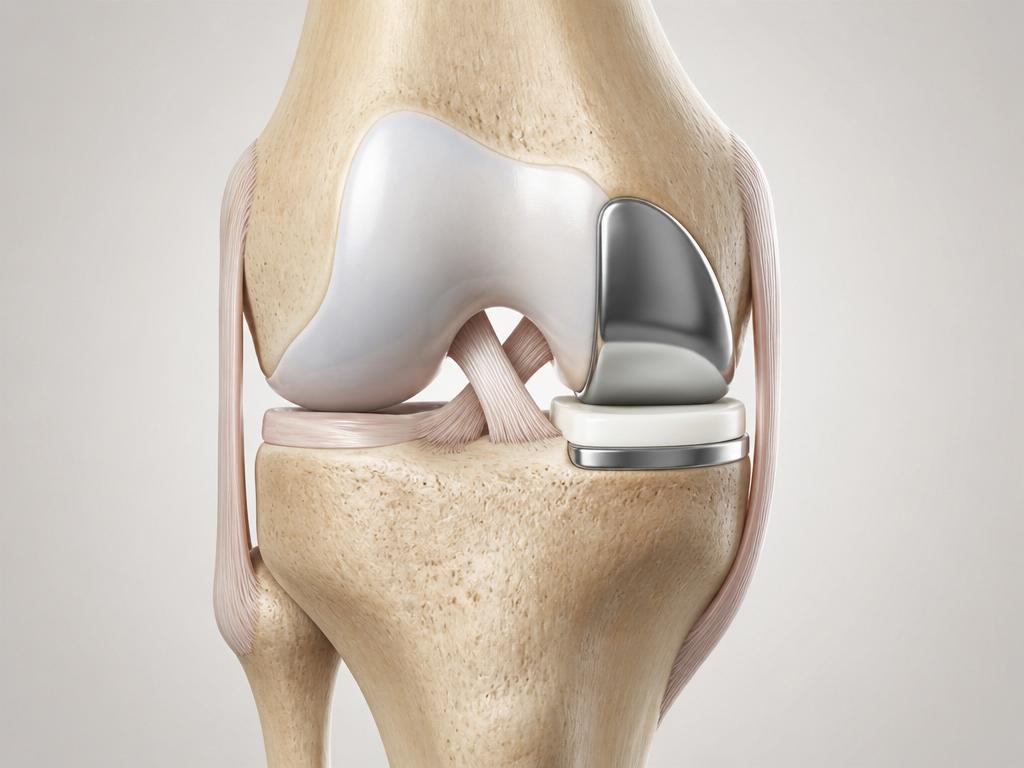
Illustration: medial compartment resurfaced; ACL, PCL, and collateral ligaments preserved.
Side by side
How is a partial knee replacement different from a total knee replacement?
Toggle to compare — bars reflect relative magnitude for illustration, not precise numbers.
An honest look
What are the trade-offs and risks of a partial knee replacement?
Higher chance of future surgery
Revision rates are somewhat higher than for a total knee.
Arthritis can progress elsewhere
The other compartments (lateral or kneecap) can wear over time and may need converting to a total knee.
Loosening or bearing slip
Implant loosening or (mobile-bearing) bearing slipping are possible failure modes.
Selection & surgeon matter
Best results depend on careful patient selection and an experienced surgeon.
The balance
For the right patient, a partial knee offers a faster, easier recovery and a more natural-feeling knee, in exchange for a somewhat higher chance of needing more surgery down the line. It's a shared decision with your surgeon.
Am I a candidate? — a starting point
Tap the ones you think apply. This isn't a decision — it's a starting point for the conversation with your surgeon, who makes the final call.
Even if only some apply, a total knee replacement is a highly successful option too.
→ Discuss with your surgeon at a consultation.
⚖️ Remember — everyone's different: not everyone is a candidate — your surgeon will tell you whether your knee is suitable. If it isn't, a total knee replacement is a highly successful option.
References
Compared with total knee replacement in large matched studies, partial (unicompartmental) knee replacement has lower mortality, fewer major complications (blood clots, heart attack, stroke, deep infection, transfusion) and shorter stays, but higher revision/reoperation rates (Liddle AD, Judge A, Pandit H, Murray DW. National Joint Registry, 101,330 matched patients. Lancet 2014;384:1437–1445; Wilson HA et al., BMJ 2019;364:l352).
A randomised controlled trial found similar clinical outcomes and revision rates at 5 years with greater cost-effectiveness (TOPKAT; Beard DJ et al., Lancet 2019;394:746–756).
Patients report at least as good or better outcomes and better proprioception from retained ligaments (Liddle AD et al., Bone Joint J 2015;97-B:793–801; Isaac SM et al., Knee 2007;14:212–217).
Commonest failure modes are progression of arthritis in the other compartments and aseptic loosening (overall revision ~8.8% at 6.5 years; systematic review, Arch Orthop Trauma Surg 2021); revision of a partial to a total knee generally does well (Pearse AJ et al., J Bone Joint Surg Br 2010;92-B:508–512). Classic candidacy criteria: Kozinn SC, Scott R. J Bone Joint Surg Am 1989;71:145–150.