Subvastus knee replacement
Subvastus quad-sparing knee replacement surgery in Calgary
The subvastus approach slips beneath the main thigh muscle rather than cutting it — protecting the engine that straightens your knee, for a smoother early recovery.
What it is, in plain terms
What is subvastus (quad-sparing) knee replacement?
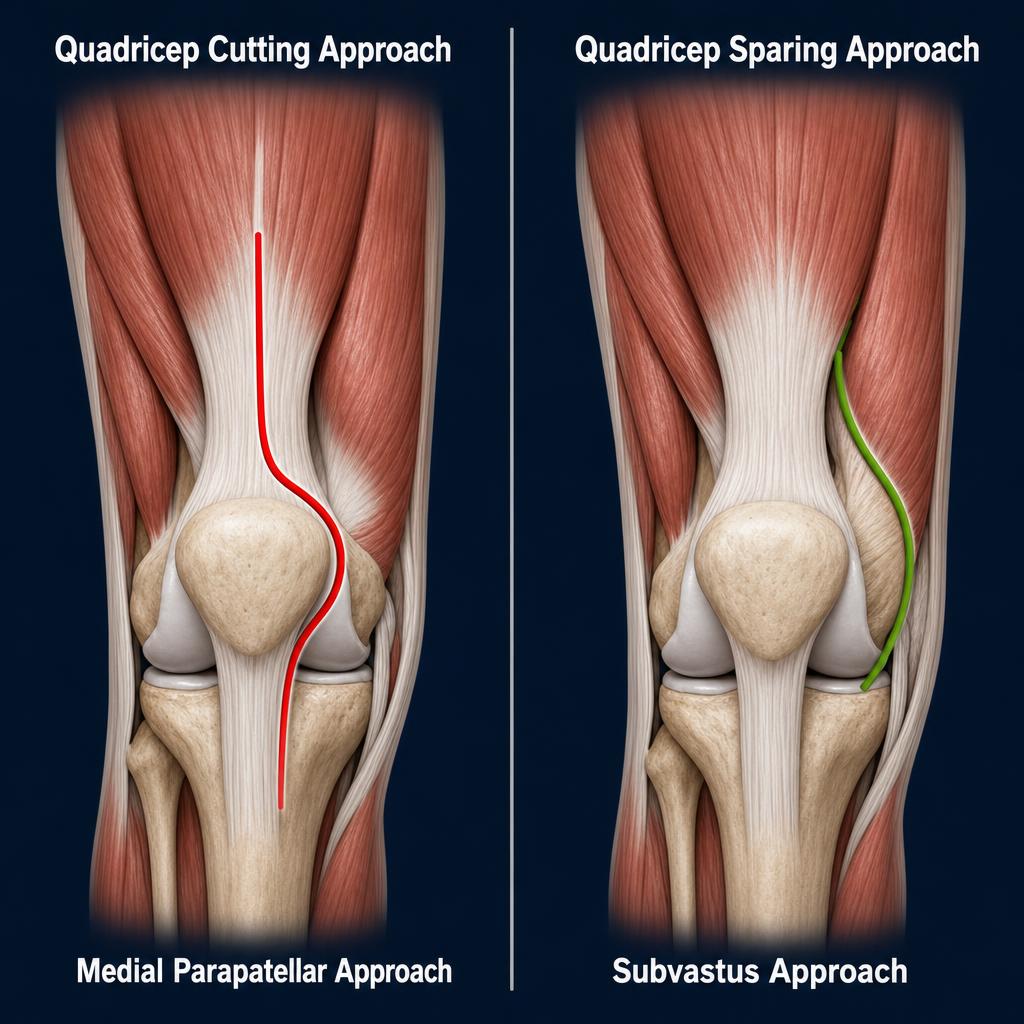
The subvastus approach is a muscle-sparing total knee replacement that reaches the joint underneath the quadriceps muscle, leaving the quadriceps tendon intact. In a total knee replacement, the worn surfaces of the knee are resurfaced with implants. Reaching the joint usually requires moving the kneecap aside. In the standard approach, this is done by cutting through a portion of the quadriceps tendon— the tendon that drives the knee straight.
The subvastus approach instead goes underneath the vastus medialis muscle, leaving the quadriceps tendon completely intact. The end result inside the knee is the same; the difference is how quickly the muscle that drives the knee comes back online.
Why it's used
What are the benefits of the subvastus approach?
Quad-sparing
The subvastus approach goes under the quadriceps muscle rather than cutting the quadriceps tendon.
Earlier straight-leg raise
Because the quadriceps is left intact, patients often regain active leg extension sooner after surgery.
Smoother early recovery
Studies of the approach report less early pain and reduced reliance on assistive devices in the first weeks.
Stable extensor mechanism
Leaving the quad tendon intact protects the extensor mechanism, the foundation of long-term knee function.
Is it right for you?
Am I a candidate for subvastus knee replacement?
The subvastus approach works well for most primary knee replacements with normal alignment; complex or revision knees may still be better served by the traditional approach. In knees with significant deformity, prior surgery, or in revision cases, a traditional medial parapatellar approach gives wider exposure and may be the safer choice. That call is made together in consultation.
The early advantage — faster return of quad strength and less reliance on assistive devices — tends to narrow over the first few months. By a year, function and implant survival are equivalent. The technique is about a gentler start, not a better final knee.
Worth asking about
Not every knee needs a total replacement.
If your arthritis is limited to one part of the knee, you may be a candidate for a partial (unicompartmental) knee replacement — a smaller operation with a faster recovery. Ask your surgeon whether it's right for you.
Learn about partial knee replacementReferences: Wilson HA et al., BMJ 2019;364:l352 · Kozinn SC, Scott R, J Bone Joint Surg Am 1989;71:145–150.
Side by side
How is the subvastus approach different from the traditional (medial parapatellar) approach?
| Aspect | Subvastus approach | Standard medial parapatellar |
|---|---|---|
| Approach | Under the vastus medialis muscle — the quadriceps tendon is not cut. | Medial parapatellar — a small incision is made through the quadriceps tendon to flip the kneecap. |
| Quadriceps strength | The extensor mechanism is left intact, so quad activation typically returns sooner. | The quad tendon heals reliably, but early straight-leg raise is often delayed. |
| Early pain & assistive use | Many patients describe less early-stage pain and shorter time on a walker. | Effective pain control is achievable, but the first 2–6 weeks typically lean on assistive devices longer. |
| Exposure | Slightly more demanding exposure; well-suited to most primary knees with normal alignment. | Excellent, broad exposure — versatile across all body types, deformities, and revisions. |
| Long-term outcome | Equivalent long-term function and implant survival when properly performed. | Equivalent long-term function and implant survival — the workhorse approach worldwide. |
Medial parapatellar — a small incision is made through the quadriceps tendon to flip the kneecap.
The quad tendon heals reliably, but early straight-leg raise is often delayed.
Effective pain control is achievable, but the first 2–6 weeks typically lean on assistive devices longer.
Excellent, broad exposure — versatile across all body types, deformities, and revisions.
Equivalent long-term function and implant survival — the workhorse approach worldwide.
Both are valid; the right choice depends on you.
Recovery Timeline
How long is recovery from subvastus knee replacement?
Most patients stand the day of surgery, return to driving and daily life around 6 weeks, and reach full recovery by 6–12 months. A typical subvastus knee replacement recovery is shown below — yours may move faster or slower.
- Day 1
Standing & active leg lift
Most patients stand the day of surgery and begin gentle range-of-motion. With the quad spared, many can perform a straight-leg raise early on.
- Week 1–2
Bending & walking
Bending past 90° is a key early milestone. Home physio focuses on flexion, extension, and walking with a shortening reliance on aids.
- ~6 weeks
Driving & daily life
Most return to driving (when cleared), longer walks, and most light activities. Swelling settles steadily.
- 3 months
Confident on stairs
Stairs feel natural again, sleep is steady, and gentle recreational activity — biking, swimming, golf — returns.
- 6–12 months
Full recovery
Final strength, balance, and endurance gains. The knee feels like part of you again rather than something to manage.
Recovery varies by person. Age, baseline fitness, and other health factors all shape the road back. The timeline above describes a typical pattern, not a personal guarantee.
Life after surgery
What is life like after subvastus knee replacement?
The goal of subvastus knee replacement is a knee that gets out of the way — so activities like walking, hiking and golf feel easy again. Many of our patients tell us the thing they missed most wasn't just walking without pain — it was the freedom to say "yes" to a hike, a round of golf, or a walk with grandchildren without planning around their knee.
With the quadriceps spared and recovery on track, the goal is simple: a knee that gets out of the way and lets you live.